Range Repair
Viking burner clicks but will not light: reading the tick
A Viking burner that ticks without catching is telling you the ignition circuit still works. Here is what the clicking rules out, the four faults behind it in the order they turn up, and what you can safely check in a Los Angeles kitchen before calling.
Written by
Keiko Mabuchi
Service technician — cooktops and ventilation · 11 years in the trade
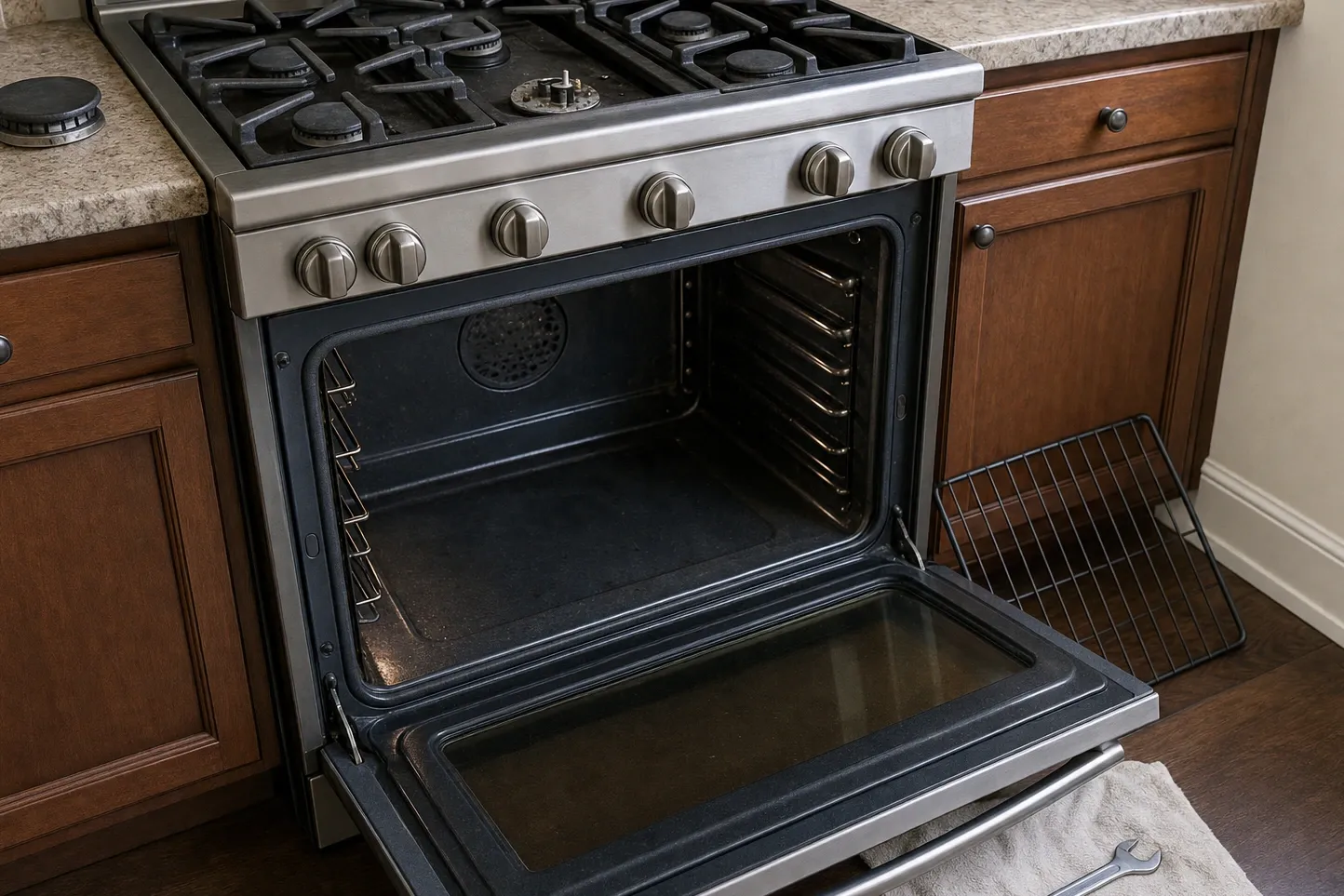
Of all the ways a Viking range can let you down, a burner that ticks away and refuses to catch is one of the kinder ones, because the tick is evidence rather than symptom. It says the spark module has power. It says the switch under that knob is closing. It says the electrode is at least trying. Everything upstream of the flame is alive. What has failed is one link near the end of the chain, and there are only four candidates worth looking at.
What the clicking actually tells you
The ignition on a sealed-burner Viking range is a spark system, not a pilot light. Turning the knob past the off position closes a switch, the module starts firing a high-voltage spark across a small gap at the edge of the burner, and the valve lets gas out of the ports. The gas reaches the spark, the flame propagates around the ring, and — on burners fitted with flame supervision — a sensor tells the valve it is safe to stay open.
So the tick you hear proves four things at once: mains power to the module, a working switch, a module that has not failed, and a wire that is still connected to that electrode. That is most of the ignition system ruled out in one second of listening. It also means the fault is almost always one of: no gas arriving at the ports, gas arriving but the spark is landing in the wrong place, the spark is too weak to light it, or the flame lights and is then shut off again because nothing proved it.
The four faults behind it, in the order they turn up
A fouled or cracked electrode. By a wide margin the most common. A pot boils over, sugar or starch bakes onto the ceramic insulator, and the spark now has a conductive or insulating film to deal with. It will often still make a noise while doing almost no useful work. A hairline crack in the ceramic is worse and is not repairable — the spark tracks down the crack to the burner body instead of crossing the gap, and the burner will never light again until the electrode is replaced.
Blocked burner ports. The gas has to arrive at the gap in a stream the spark can catch. After a spill, the ports nearest the electrode clog first, so the burner sounds like it is being fed but nothing reaches the ignition point. This is the fault that clears with a careful clean and comes back three months later if the spill was never dealt with properly underneath the cap.
A stiff or dry valve stem. Los Angeles kitchens run these ranges hard for years and the grease in the valve stem eventually hardens. The knob feels heavy, and at the click position the valve is only barely cracked open — not enough gas for the spark to catch, though it lights readily once you push the knob further round. A valve that needs two hands is telling you this before the burner does.
Flame supervision that is not proving the flame. On burners fitted with a thermocouple or a similar device, the flame has to heat that sensor within a few seconds or the valve closes again. The symptom is distinctive: it lights, burns for two to five seconds, and dies. People describe that as clicking too, because the clicking resumes afterwards.
What you can check safely yourself
Turn the burner off and let everything cool completely first. Then, with the gas knob firmly off:
- Lift the cap and the burner ring off. They are not fastened on most sealed burners; they sit in place. Look at the small ceramic-and-metal spike at the edge. Is it wet, brown, crusted, or visibly cracked?
- Clean the ceramic with a dry brush and then a cloth with a little rubbing alcohol. Nothing abrasive, and nothing wet going down into the burner.
- Look into the ports around the ring. Hold them up to the light. A straightened paperclip clears a blocked port; a drill bit or a needle will widen it and change the flame shape permanently, so do not use either.
- Put it all back exactly seated. A cap sitting proud by a millimetre moves the gas away from the spark and reproduces the whole fault on a burner that is otherwise fine.
- Compare knobs. If the failing burner’s knob feels noticeably heavier than its neighbours, you have found a valve, not an igniter.
If it lights after cleaning and stays lit, you are done. That is a genuinely common outcome and it costs nothing.
When it stops being worth chasing
Three signals say stop. A cracked ceramic on the electrode — cleaning cannot fix a crack. A burner that lights and dies after a couple of seconds, because that is the safety circuit doing its job and it needs a meter, not a brush. And any smell of gas that lingers after the knob is off, which is not a diagnostic puzzle at all: shut the supply off at the valve and get someone out.
The other reason to stop is time. A 48-inch range with a griddle has a lot of burners, and if two or three are behaving badly at once the answer is usually one shared part — a spark module rather than four separate electrodes — which is a cheaper repair than the symptoms suggest and not one you can confirm from the kitchen floor.
What a visit looks like
Diagnosis here is charged as a flat $89 — the drive out and the whole examination, in one figure. On this fault that means the caps come off, every electrode is inspected under light, the spark gap is checked, the module output is tested, and where flame supervision is fitted the sensor is measured rather than guessed at. You get told which of the four it is, and what the repair costs, before anything is replaced.
Electrodes, spark modules and burner valves for the common families ride on the van, so most clicking-burner calls close on the first visit. Read the model and serial off the rating plate to the phone call if you can find it, and if you cannot, count the knobs and the oven doors instead — either is usually enough to get the right parts loaded before anyone sets off.
If every burner ticks together and none of them light, the component to read about is the spark module.
If it is one stubborn ring, it is almost certainly its own electrode.
Loose ends
Is a clicking burner dangerous to keep using?
Clicking on its own is not, but a burner that eventually lights with a soft thump has been filling the area around the cap with unburnt gas while it clicked. Turn the knob off, wait a full minute, and try once. If it takes more than two attempts, stop using that burner and get it looked at rather than persisting.
Why does it light if I hold the knob in?
Holding the knob keeps the valve open manually. On a burner with a flame-supervision device, that is a strong hint the thermocouple or the safety valve is not proving the flame, so the gas shuts the moment you let go. On a spark-only burner it usually means the valve stem is stiff and is not opening fully at the click position.
One burner clicks, but so do the others at the same time. Is that normal?
On many spark modules all electrodes fire together from one module, so hearing every burner tick when you turn one knob is normal behaviour, not a fault. What matters is which burner lights and which does not. If every burner clicks and none lights, look at gas supply before ignition.
Can a boil-over really kill an igniter?
It is the single most common cause we see. Sugar and starch cook onto the ceramic of the electrode and form an insulating shell, so the spark either weakens or jumps to the wrong place. Cleaning it sometimes brings it back; a cracked ceramic never comes back and the electrode has to be replaced.