Range Repair
What Is a Viking Stove? How Its Burners and Oven Work
A Viking stove is a professional-style range: a heavy stainless cooktop of high-output gas burners set over a large oven, built for home kitchens. Here is how its burners, spark ignition and oven work, and why those parts explain the faults owners notice.
Written by
Keiko Mabuchi
Service technician — cooktops and ventilation · 11 years in the trade
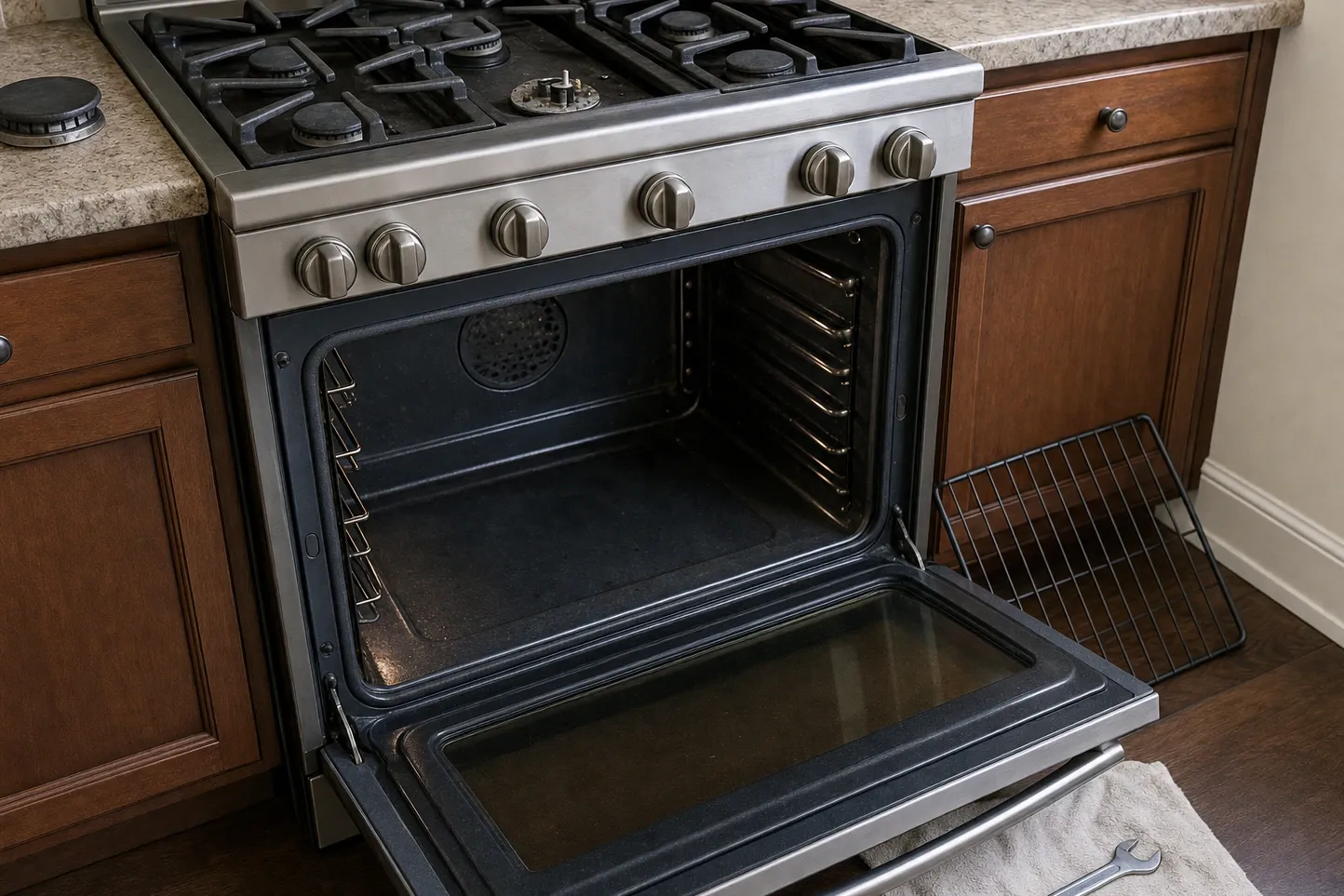
A Viking stove is a professional-style gas or dual fuel range made for home kitchens: a stainless steel cooktop of powerful burners under heavy cast-iron grates, mounted over a deep oven, with chunky metal knobs rather than a glass touch panel. A 5 Series gas model puts out 15,000 BTU from every sealed burner when it runs on natural gas, and some models add a TruPower Plus burner at the front right that reaches 18,500 BTU. That is far more heat than a typical builder-grade stove offers, and the hardware that delivers it is also what produces the clicking, hissing and slow lighting that owners in Encino, Mar Vista and Larchmont Village search for answers about.
What sets it apart from an ordinary stove
Three things. First, mass: the frame, grates and oven walls are thick, so the range holds heat and stays steady when a heavy stockpot lands on it. Second, output: the burners are sized like restaurant burners, yet the knob still turns them from a hard boil down to a low simmer. Third, simplicity: most Viking gas ranges are controlled mechanically, with a gas valve behind each knob and electricity used mainly for the spark. Fewer electronics means fewer things to fail, but the few that are there work hard.
Viking sells several families. The 5 Series runs from 30 to 60 inches wide, and its prefixes tell you the fuel: VGR for gas with sealed burners, VGIC for gas with open burners, VDR for dual fuel, VER for all-electric and VIR for induction. The 3 Series is a 30-inch line, and the 7 Series comes in 36- and 48-inch widths with Elevation Burners, which raise the flame ports so spills do not bake onto them. Tuscany ranges are dual fuel, pairing gas burners on top with an electric oven below.
How the burners make their heat
Gas leaves the manifold behind the knobs, passes through a valve, and travels to a small brass orifice at the base of each burner. There it mixes with air, rises into the burner head and leaves through a ring of tiny ports where the flame forms. A cap sits on top to spread the gas evenly around that ring.
On a sealed burner the base is closed off from the cooktop, so a boil-over stays on the surface where you can wipe it. On an open burner, the type used in VGIC models, there is a drip pan underneath and more air reaches the flame, which some cooks like for searing. Either way, the burner works only as well as its ports and cap allow: a cap resting a few millimeters off center, or ports packed with dried sauce, gives a lopsided, yellow or lazy flame.
A 5 Series gas range also carries its own pressure regulator, set to 5.0 inches of water column on natural gas or 10.0 on LP, and it must never be bypassed. When one burner is weak, the regulator is rarely to blame; when every burner goes weak at once, the supply is the first suspect.
The spark, the click and automatic relight
Turn a knob toward light and a switch behind it tells a spark module to fire. Each burner has an electrode, a small ceramic post with a metal tip, and the module sends rapid pulses that jump from that tip to the burner. That is the ticking you hear.
On 5 Series ranges the spark also guards the flame. If the flame goes out while gas is still flowing, the system clicks again and relights the burner by itself. That is useful, but it also means a burner that keeps ticking after it has lit is telling you something: often moisture left from cleaning, a crooked cap, or an electrode that is cracked or coated with grease.
Total silence calls for the simple checks first, with the knob returned to off: is the plug still in the wall, and has a breaker or fuse in the panel cut the power? Silence on every burner with power present points to the spark module; silence on just one points to its knob switch or wire. If you hear ticking but get no flame, the step-by-step diagnosis is in our guide to a Viking burner that clicks but will not light.
In Los Angeles there is one more cause to rule out. Many houses have a seismic shutoff valve at the gas meter, and a small quake or an accidental bump can close it, leaving a range that sparks perfectly over burners with no gas to burn. Our page on no gas after a jolt explains how to tell.
Inside the oven
A 5 Series gas oven uses a single 30,000 BTU bake burner, shaped like a U, under the oven floor and a Gourmet-Glo infrared broiler across the ceiling, both lit by Viking’s SureSpark ignition. There are six rack positions. Viking describes its gas oven as best for broiling and baking on one rack, while its electric ovens with Vari-Speed Dual Flow convection suit several racks at once, which is a big reason buyers pick dual fuel.
Self-cleaning is the oven’s hardest job. The cavity can reach 750°F, the cycle usually lasts 3 to 3½ hours depending on the model, and then it needs roughly 30 more minutes to cool. That heat ages door gaskets, sensors and wiring over the years, so oven faults often appear right after a clean.
Why owners call, and what fixing it costs
Most problems trace back to the parts described above: spark electrodes, burner caps and ports, knob switches, the spark module, and the oven’s burner or element. These are replaceable parts on a frame built to last, so repair usually makes sense. As typical ranges, an igniter or burner assembly runs $170–$480 and an oven thermostat or heating element $210–$480, well under the price of replacing the whole range. We give a firm price only after diagnosis. The visit costs $89 for the drive and the full inspection, and that fee comes off the bill when you go ahead with the repair. What we work on is listed on our Viking range repair page, or call (213) 516-4020.
Loose ends
Is a Viking stove the same thing as a Viking range?
Yes, in everyday speech both words name the same appliance: a cooktop and an oven joined in one freestanding unit. Viking itself calls them ranges. A rangetop is the burner section alone, built into the counter, and a wall oven is the oven alone, set into cabinetry.
Why does my Viking stove click but the burner never lights?
Clicking with no flame usually means the spark is working but gas is not reaching the burner cleanly, or the spark is jumping somewhere it should not. A crooked burner cap, wet or blocked ports, or a closed gas supply are the usual causes. Reseat the cap, let the burner dry and see whether the other burners light before you call.
What should I check if the igniter does not click at all?
Return the knob to off first, and only then make sure the cord is seated in the outlet and the circuit feeding the range is live, with no tripped breaker or blown fuse. That is the order Viking gives in its 5 Series manual. If every burner stays silent with power present, the spark module or a knob switch is the likely part.
How do I find which Viking model I own?
Look for the rating plate. A 5 Series gas range hides it in one of three spots: the left side panel beneath the front grate support, the frame just under the knobs on the oven front, or the underside of the control panel once the door is open. On 7 Series ranges open the oven door and look under the control panel; on Tuscany ranges pull out the storage drawer.
Is it worth repairing an older Viking stove?
Usually yes, because the frame, grates and burner bowls outlast the parts that wear. An igniter or burner assembly job typically runs $170–$480, a small share of what a comparable new Viking range costs. The firm figure comes after diagnosis, and the $89 visit fee drops off once you approve the work.